Research at the University of Leicester can even give us a clue as to what Richard III sounded like. Dr Philip Shaw, Lecturer in English Language and Old English in our School of English, has studied two letters written by Richard when he was Duke of Gloucester. In the podcast below, you can hear Dr Shaw read these letters using the approximate pronunciation and accent that we believe Richard would have used. Interestingly, the language and spelling betrays no sign of a northern dialect, being closer to what we now consider a West Midlands accent.
Showing posts with label archaeology. Show all posts
Sunday, 13 December 2015
Wednesday, 9 December 2015
Earliest Gun Flints Discovered
Gun flints were thought not to have been used until the mid-seventeenth century, but a new find at the stronghold of Clan Morrison on Dùn Èistean excavation
has unearthed gun flints dating to the sixteenth and early seventeenth centuries. Other finds from the site indicate the participation of the island’s residents in maritime trade.
Image credit: University of Glasgow
Tuesday, 8 December 2015
The extent of Isis’ antiquities trade
As we have written about a couple of times in the past, Isis is engaged in the systemic destruction of ancient sites and artefacts in Syria but at the same time, as the warnings from the FBI indicate, they are selling artefacts to fund their activities.
Andrew Keller, a senior official at the State Department revealed declassified documents at the Met proving that Isis is running a business selling artefacts. The documents reveal the structure of the antiquities business and are informed by documents that were seized by US Special Forces.
After some recent changes Isis now manages oil and antiquities under the same bureaucratic umbrella, the “Diwan al-Rikaz,” an archaic phrase that literally translates to “Department of Precious Things That Come Out of the Ground.”
Isis treats most antiquities as a natural resource, ripe for extraction and profit. A chart found in the raid shows that Abu Sayyaf, who recently took responsibility for the Isis antiquities trade, dispatched investigation teams to identify places “that are anticipated to have precious things,” then licensed locals to excavate the sites with shovels or rented backhoes.
Although the cynical might believe that Isis is spouting a doctrine regarding idolatry whilst only destroying objects/sites to big to sell, documents reveal that the group warns of the consequences for anyone caught “dealing in idolatrous antiquities and ephemeral statues” suggesting that they have a defined stance on idolatry.
Keller also said that a handful of receipts discovered on Abu Sayyaf’s hard drive show that, during his six-month tenure, the Syrian branch of the antiquities division collected at least two hundred and sixty-five thousand dollars in taxes—a notable sum, but hardly a drop in the billion dollars that Isis amassed last year, according to State Department estimates.
Wednesday, 2 December 2015
dinosaur footprints found on beach
Footprints belonging to sauropods that plodded through a lagoon in the middle Jurassic period have been uncovered on a beach on the Isle of Skye.
Researchers from the University of Edinburgh have discovered hundreds of footprints on a slab of rock reaching out to sea on the north eastern tip of the island. The tracks were preserved when sediments washed into the footprints left in the lagoon bed after the animals had passed. Some are now visible as dents the size of bin lids, others as casts, created when the stone around them weathered away.
Wednesday, 25 November 2015
1922 – Howard Carter and Lord Carnarvon enter the tomb of Tutankhamun
26 November
Howard Carter and Lord Carnarvon become the first people to enter the tomb of Pharaoh Tutankhamun in over 3000 years.
In 1907 Carter was employed by Lord Carnarvon to supervise Carnarvon's Egyptian excavations in the Valley of the Kings. The intention of was to ensure that Howard Carter imposed modern archaeological methods and systems of recording.
Carnarvon financed Carter's work in the Valley of the Kings to 1914, but until 1917 excavations and study were interrupted by the First World War. Following the end of the First World War, Carter aggressively resumed his work. After several years of finding little, Lord Carnarvon became dissatisfied with the lack of results, and in 1922 informed Carter that he had one more season of funding to search the Valley of the Kings and find the tomb.
On 4 November 1922, Howard Carter's excavation group found steps which Carter hoped led to Tutankhamun's tomb (subsequently designated KV62) (the tomb that would be considered the best preserved and most intact pharaonic tomb ever found in the Valley of the Kings).
He wired Lord Carnarvon to come, and on this day in 1922, with Carnarvon, Carnarvon's daughter and others in attendance, Carter made the "tiny breach in the top left hand corner" of the doorway. He was able to peer in by the light of a candle and see that many of the gold and ebony treasures were still in place. He did not yet know whether it was "a tomb or merely a cache", but he did see a promising sealed doorway between two sentinel statues. When Carnarvon asked "Can you see anything?", Carter replied with the famous words: "Yes, wonderful things!"
The next several months were spent cataloguing the contents of the antechamber under the "often stressful" supervision of Pierre Lacau, director general of the Department of Antiquities of Egypt. On 16 February 1923, Carter opened the sealed doorway, and found that it did indeed lead to a burial chamber, and he got his first glimpse of the sarcophagus of Tutankhamun. All of these discoveries were eagerly covered by the world's press, but most of their representatives were kept in their hotels; only H. V. Morton was allowed on the scene, and his vivid descriptions helped to cement Carter's reputation with the British public.
Carter's own notes and photographic evidence indicate that he, Lord Carnarvon and Lady Evelyn Herbert entered the burial chamber shortly after the tomb's discovery and before the official opening.
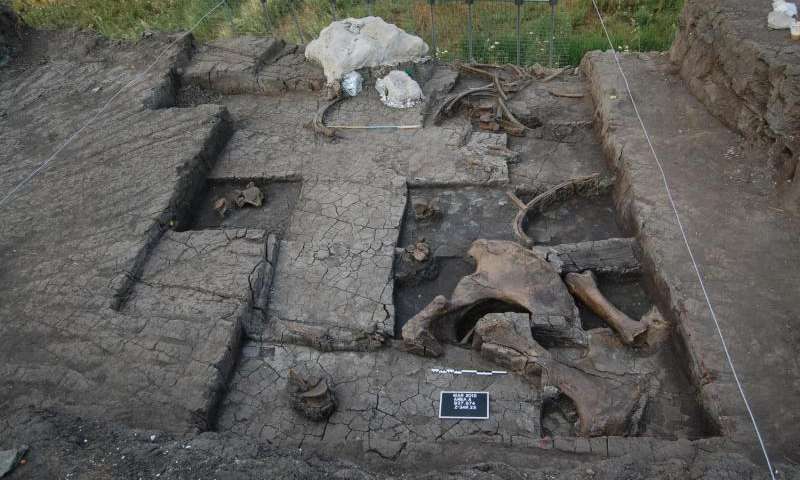
Elephant butchered at one of the oldest sites in Greece
Researchers have discovered a number of stone tools and a near complete elephant skeleton dating to 300,000-600,000 years ago at Megalopolis in Greece.
It is certain that the elephant was actually butchered and not just coincidentally found near the tools as is evidenced by the cut marks on the beasts bones.
Tuesday, 24 November 2015
1974 – Discovery of the 40% complete Australopithecus afarensis skeleton, nicknamed "Lucy"
Lucy is the common name of AL 288-1, several hundred pieces of bone fossils representing 40 percent of the skeleton of a female of the hominin species Australopithecus afarensis. Lucy was discovered in 1974 near the village Hadar in the Awash Valley of the Afar Triangle in Ethiopia by paleoanthropologist Donald Johanson.
The Lucy specimen is an early australopithecine and is dated to about 3.2 million years ago. The skeleton presents a small skull akin to that of non-hominin apes, plus evidence of a walking-gait that was bipedal and upright, akin to that of humans (and other hominins); this combination supports the (debated) view of human evolution that bipedalism preceded increase in brain size.
"Lucy" acquired her name from the song "Lucy in the Sky with Diamonds" by the Beatles, which was played loudly and repeatedly in the expedition camp all evening after the excavation team's first day of work on the recovery site. After public announcement of the discovery, Lucy captured much public interest, becoming almost a household name at the time.
Beginning in 2007, the fossil assembly and associated artefacts were exhibited publicly in an extended six-year tour of the United States; the exhibition was called Lucy’s Legacy: The Hidden Treasures of Ethiopia. Lucy became famous in the US and around the world, and was returned to Ethiopia in 2013.
Monday, 23 November 2015
Making Roman Bread
Sunday, 22 November 2015
Revisiting the world’s oldest winery
In revisit of an earlier story the darker side of the world’s oldest winemaking facility has been revealed. Analysis of the pottery vats found at the site has revealed that children were sacrificed as part of the wine making process. The head excavator Dr Boris Gasparyan as suggested that rather than being a winery per se the site was in fact a location for the performance of fertility rights associated with agricultural activity.
Apparently the blood of children was added to pots of fermenting juice which will later utilised during fertility rituals. interestingly the vats have also provided evidence to suggest that the wine was drunk directly from them utilising straws, and that the wine itself which may still have been undergoing the process of fermenting and hence contained active CO2 gas making it a sparkling wine.
SHARE THIS:
7,000 cult items found in tiny excavation pit
Excavations at Yavneh, located about 20 kilometers south of Tel Aviv in Israel, which were conducted in one of the smallest imaginable archaeological pits (2m across by 1.5m deep) have revealed a total of 7,000 cult objects dating to the 8th and 9th Centuries BC. Interesting finds include 120 cult stands manufactured to resemble temples, and the fact that a large number of objects contained residue of hallucinogenic substances.
Featured image: Cult stand from Yavneh (Credit: Raz Kletter/ Israel Antiquities Authority)
Monday, 9 November 2015
One step closer to finding the tomb of Nefertiti
In what is possibly the best evidence yet that Nicholas Reeves’ theory that Tutankhamen is to contains additional chambers has legs. Scientists from the Ministry of antiquities, Cairo University and the Heritage Innovation and Preservation Institute in Paris conducted a scan on the inside of Tutankhamen’s tomb using Infrared thermography technology last week.
Sunday, 8 November 2015
Iraqis to be trained in rescue archaeology
The British Museum has announced a five-year program that will train some 50 Iraqi heritage professionals to deal with the damage inflicted on heritage sites by the likes of Isis. the program has won a £3 million government grant to train local museum curators, conservation technicians and heritage protection archaeologists in methods of conservation and restoration.
Saturday, 7 November 2015
Free History Bytez Magazine Issue 1 available
November 2015 Issue (68 pages)
Contents:
Linothorax Armour
Sahariano Tank
Infographic – Major Roman Battles
R.I.C 14 gold Aureus of Nerva
The battle of Megiddo
Retro recipe: Roman tuna steaks
Reviews
Sahariano Tank
Infographic – Major Roman Battles
R.I.C 14 gold Aureus of Nerva
The battle of Megiddo
Retro recipe: Roman tuna steaks
Reviews
Monday, 26 October 2015
Screen shot from the Free History Bytez Magazine
We’ve been working hard to put together the first ever History Bytez magazine, and have some great stories for you. As we have mentioned the magazine won’t cost you a cent, and we’re planning on keeping it that way. If anyone would like to advertise in the magazine (that’s how we’re hoping to fund it) please contact us at historybytez@gmail.com discounted ad placements are available for the first 3 issues.
We hope you are all as excited to see the first issue come out as we are. Please share the news with anyone that might be interested we need distribution to make this a success and keep the magazine free for readers.
SHARE THIS:
Sunday, 25 October 2015
Restoration of Tut’s beard video
You might remember a story we put up some time ago about the mask of Tutankhamen being damaged and the beard breaking off as a result. The curators epoxied (yes they used epoxy) the beard back on leaving an unsightly join and damaging the mask. the German government offered to pay for repairs and a polish to fix the mask up. Attached below is a short video of the restoration crew working on the mask.
Tuesday, 20 October 2015
Viking outpost in Canada
Archaeologist Patricia Sutherland has been putting together a compelling case for the discovery for the second viking outpost ever discovered in the Americas. Whilst working on the Island of Baffin Sutherland found whetstones containing cupric-alloy traces, indicating the presence of bronze which was unknown to the native inhabitants but used by the viking metalsmiths.
Sunday, 18 October 2015
Largest Neolithic site on Anglesey Discovered
An important neolithic site has been discovered by archaeologists surveying the site for a new school.
Thursday, 15 October 2015
Glass spearhead found at Rottnest
It’s the third time in the past year that UWA staff and students have uncovered spearheads on the island.
Earlier this year a Heritage Studies student found a glass spearhead, and last year a staff member unearthed a ceramic one.
The spearheads are believed to have been used by Indigenous men and boys who were imprisoned on island between 1838 and 1931.
Records show photographs of Sunday hunting day when the Indigenous prisoners would hunt to supplement their diet of barley, cabbage and porridge with fish, snake and quokka.
It is believed the prisoners would find a place on top of a hill often overlooking the mainland where they would make spear tips from scrap pieces of glass.
Professor Len Collard from UWA’s School of Indigenous Studies said the most recent discovery occurred when the 45 students and eight staff from the UWA School of Indigenous Studies were learning about the history of Indigenous prisoners on the island.
“As I was digging around in the sand with my foot, something shiny glinted in the light and I recognised the object to be a glass spearhead,” Professor Collard said.
Wednesday, 14 October 2015
Viking fortress about to be excavated near Copenhagen
Last September the Viking age fortress was discovered in Denmark for the first time in 60 years, the fortress was discovered in part as a result of the use of drone technology. Although Vikings were in a number of countries circular Viking fortresses are unique to Denmark, this particular fortress, named the Vallo ring-fortress, is 145 m in diameter making it the third largest of the five that have thus far been found in Denmark. so far archaeologists have been able to determine that the ring-fortresshad 7 m high palisade walls
Archaeologists are now prepared to start a three-year excavation project at the site after receiving nearly 25,000,000 kroner in grants. the project will be handled jointly by the museum of South East Denmark and Aarhus University.
Featured image credit: Museum Sydøstdanmark
Subscribe to:
Posts (Atom)